Pizza Hut nutrition guide
Pizza Hut Breadsticks Calories per Stick and per Order
See Pizza Hut breadsticks calories per stick, calculate common quantities, and learn how dipping sauce and the rest of the meal affect the total.
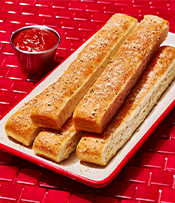
Pizza Hut breadsticks have 140 calories per stick in the July 28, 2026 nutrition snapshot used by this site. Two sticks are 280 calories, three are 420, and five are 700 before any separately consumed dipping sauce. The source row is per stick, so the most reliable way to estimate a serving or order is to count the number actually eaten instead of assuming every box or bundle contains one universal quantity.
Breadsticks nutrition per stick
One Pizza Hut breadstick is listed at 140 calories, 4.5 grams of total fat, 1 gram of saturated fat, 260 milligrams of sodium, 19 grams of carbohydrate, 1 gram of fiber, 1 gram of sugar, and 4 grams of protein. That complete per-stick row is the correct starting point for any quantity calculation in this catalog snapshot.
Because the serving is one stick, every displayed nutrient scales with the quantity. Three sticks are not only 420 calories; they also total 13.5 grams of fat, 780 milligrams of sodium, 57 grams of carbohydrate, and 12 grams of protein by multiplication. Counting the number eaten keeps the calories and the rest of the nutrition receipt aligned.
- One stick: 140 calories.
- Two sticks: 280 calories.
- Three sticks: 420 calories.
- Five sticks: 700 calories.
Do not guess the order count from the container
The committed national-menu nutrition contract establishes a per-stick value, but it does not guarantee one fixed number of sticks in every local order, deal, buffet serving, or bundle. Availability and packaging can vary. If the order contains a quantity shown by the restaurant, use that number; if the breadsticks are shared, count the portion you personally ate.
This avoids two common mistakes: logging one stick for an entire shared order or assigning a guessed full-box total when only part was eaten. If pieces were cut or torn, an estimate may be necessary, but it is more transparent to record an approximate fraction than to claim a precision the physical serving does not support.
Dipping sauce is a separate line
The 140-calorie breadstick row describes the breadstick itself. A marinara cup, ranch, garlic sauce, or another dip adds its own nutrition when it is ordered and consumed. Do not assume a dip is included in the 140 calories, and do not add one when no sauce was eaten. Use the exact supported dipping-sauce serving as a separate calculator line.
Sharing a cup also changes the estimate. If several people use one dip, the full cup should not be assigned to every person. Divide it according to the approximate amount consumed, while acknowledging that shared dipping is difficult to measure precisely. Keeping the sauce separate at least makes the source of the additional calories, fat, sodium, or carbohydrate visible.
Breadsticks can change a pizza meal quickly
Suppose a meal contains two large Hand Tossed cheese slices and two breadsticks. The pizza contributes 620 calories and the breadsticks add 280, producing 900 before a drink or dip. Two large Hand Tossed pepperoni slices with three breadsticks would be 640 plus 420, or 1,060 calories before other items. These examples use separate official rows rather than a generic combo estimate.
The same approach works with wings or Melts. Add the entrée first, then add the exact breadstick quantity. This shows whether a change comes from the main item, the side, the sauce, or all three. It also makes it easier to compare eating one fewer stick with changing the pizza crust or wing flavor.
Sodium and allergens scale with quantity too
At 260 milligrams of sodium per stick, two breadsticks are 520 milligrams, three are 780, and five are 1,300 by multiplication. A sauce or seasoned entrée can add more. This is planning information rather than medical guidance, but it demonstrates why the number of sticks matters even when the calorie arithmetic is already familiar.
The breadstick row carries affirmative flags for gluten, milk, soy, and wheat in this snapshot. Shared kitchens, supplier changes, and restaurant handling mean those flags are not a complete allergy-safety determination. Review current official allergen information and speak with restaurant staff whenever an allergy or strict dietary restriction affects the order.
Calculate the quantity you actually eat
Open the Pizza Hut calorie calculator, choose Breadsticks, and set the meal quantity to the number of sticks you expect to eat. Add a supported dipping sauce separately if you plan to consume it. Then add pizza slices, wings, pasta, dessert, and drinks as their own lines so every component remains visible.
Review the full receipt rather than calories alone, especially when sodium, carbohydrate, fat, protein, or allergens matter. The site’s nutrition methodology explains how serving quantities and dated official rows are handled. Verify current Pizza Hut information for recipe, serving, ingredient, allergen, or availability changes before ordering.