Pizza Hut nutrition guide
Pizza Hut Melts Calories: Half vs Whole Nutrition Guide
Compare Pizza Hut Melts calories for official half and whole servings across Meat Lover’s, Chicken Bacon Parmesan, Buffalo Chicken, and Pepperoni Lover’s.
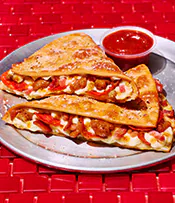
Pizza Hut Melts calories depend on both the filling and whether the official serving is a half or whole Melt. In the July 28, 2026 catalog used by this site, half servings range from 560 to 690 calories and whole servings range from 1,080 to 1,170. Use the published whole row when eating a full Melt: the whole value is not consistently exactly twice the half, so doubling the half can produce the wrong result.
Pizza Hut Melts calories at a glance
The Meat Lover’s Melt is listed at 560 calories for a half and 1,080 for a whole. Chicken Bacon Parmesan is 690 for a half and 1,170 for a whole. Buffalo Chicken is 610 for a half and 1,100 for a whole. Pepperoni Lover’s is 580 for a half and 1,130 for a whole. Those eight official rows should be treated as distinct servings rather than one row plus an assumed multiplier.
The lowest half value in this snapshot is Meat Lover’s at 560 calories, while the highest is Chicken Bacon Parmesan at 690. For whole servings, Meat Lover’s is lowest at 1,080 and Chicken Bacon Parmesan is highest at 1,170. The calorie range is relatively narrow among the whole products, but their fat, carbohydrate, protein, sodium, ingredients, and flavor profiles still differ.
- Meat Lover’s Melt: 560 calories for a half; 1,080 for a whole.
- Chicken Bacon Parmesan Melt: 690 calories for a half; 1,170 for a whole.
- Buffalo Chicken Melt: 610 calories for a half; 1,100 for a whole.
- Pepperoni Lover’s Melt: 580 calories for a half; 1,130 for a whole.
Why a whole Melt is not simply half times two
Doubling the Meat Lover’s half gives 1,120 calories, but the official whole row is 1,080. Doubling Chicken Bacon Parmesan gives 1,380, while the whole row is 1,170. Buffalo Chicken would be 1,220 by doubling but is officially 1,100, and Pepperoni Lover’s would be 1,160 instead of the listed 1,130. The difference is too large to dismiss for some products.
The half and whole labels refer to separate published items in the source data, not a promise that every ingredient scales in a perfect two-to-one relationship. Portion construction, source definitions, and recipe details may differ. Select Half Melt when that is the serving eaten and Whole Melt when the full product is eaten; do not manufacture a whole value when an official one already exists.
Protein, fat, and carbohydrate comparison
For a whole serving, Meat Lover’s has 60 grams of fat, 87 grams of carbohydrate, and 49 grams of protein. Chicken Bacon Parmesan has 71 grams of fat, 85 grams of carbohydrate, and 49 grams of protein. Buffalo Chicken has 54 grams of fat, 110 grams of carbohydrate, and 44 grams of protein. Pepperoni Lover’s has 63 grams of fat, 88 grams of carbohydrate, and 53 grams of protein.
The highest calorie Melt is not the highest in every nutrient. Chicken Bacon Parmesan has the highest whole calories and fat, Pepperoni Lover’s has the highest listed protein, and Buffalo Chicken has the highest carbohydrate value. Review the complete nutrition profile and serving size rather than ranking the products by a single number.
Whole Melt sodium varies substantially
The whole Chicken Bacon Parmesan Melt is listed at 2,430 milligrams of sodium, Pepperoni Lover’s at 2,550, Meat Lover’s at 2,580, and Buffalo Chicken at 3,870. The Buffalo Chicken row is therefore much higher in sodium even though it is not the highest-calorie whole Melt. A calorie-only comparison would miss that difference.
Half servings also contain meaningful sodium: 1,390 milligrams for Meat Lover’s, 1,410 for Chicken Bacon Parmesan, 1,560 for Buffalo Chicken, and 1,370 for Pepperoni Lover’s. These values are neutral planning information, not individual medical guidance. Include separately consumed sides, dips, and drinks when reviewing the complete order.
Sides, dips, and allergens remain separate decisions
A Melt row describes the named half or whole product. Breadsticks, fries, wings, dipping cups, desserts, and drinks add their own nutrition and should not be assumed to be included in the Melt total. If a deal bundles a side or drink, add each supported component separately in the calculator so the receipt shows what contributes to the final meal.
The Melt rows include affirmative allergen flags such as gluten, milk, soy, and wheat in this snapshot, but restaurant kitchens use shared preparation areas and ingredients can change. An independent calorie total cannot prove allergy safety. Review current official allergen information and ask restaurant staff when an allergy, intolerance, or strict restriction affects the order.
Choose the exact Melt serving in the calculator
Open the Pizza Hut calorie calculator, choose the named Melt, and select Half Melt or Whole Melt. The calculator resolves that exact official row rather than multiplying one serving into another. If two people split a whole product but the source provides a half row, use the half serving for each person only when that matches what was actually divided and eaten.
Add dips, sides, wings, desserts, and drinks separately, then review calories, fat, carbohydrate, protein, sodium, and allergens together. The site’s nutrition methodology explains serving rules and dated-source limitations. Confirm current Pizza Hut information before relying on a result for a new recipe, ingredient, allergen, or availability question.